How to Ask a Customer to Pay Their Udhar Without Losing Them
Himanshu Tunwal
Founder, Vyop
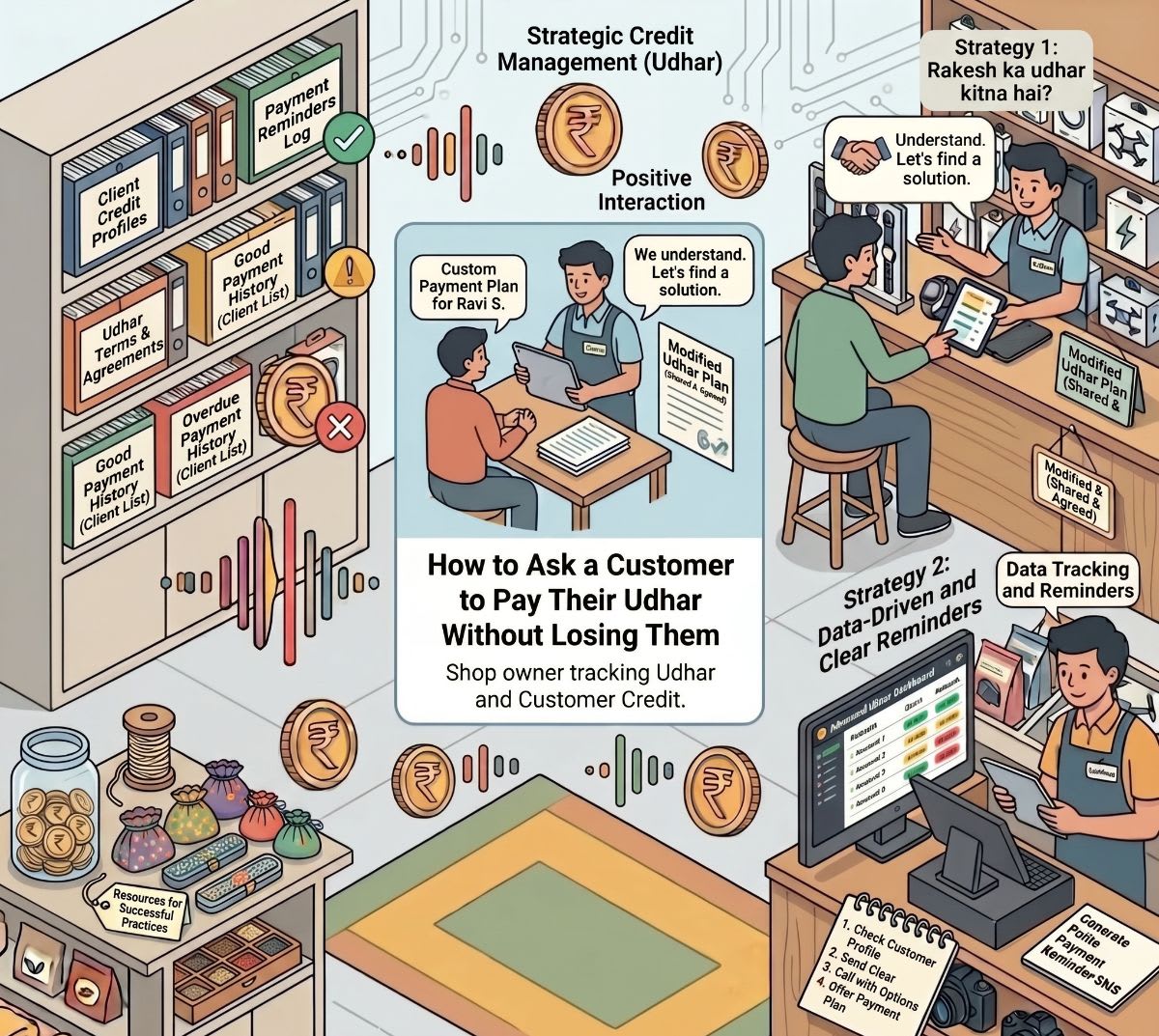
Every kirana shop owner knows this feeling — a regular customer walks in, you know they owe you ₹800, they know they owe you ₹800, and neither of you says anything. This is the silent killer of udhar recovery in every kirana shop across India. The longer you wait, the harder it gets.
Why Most Shop Owners Never Recover Their Udhar
It is not because customers are dishonest. Most customers intend to pay. The real reason udhar never gets recovered is because the shop owner has no system — no record the customer can see, no reminder that feels natural, and no way to bring it up without it feeling like an accusation.
When you ask "aapka ₹800 baaki hai" without any proof in your hand, the customer either gets defensive or promises to pay "kal pakka" — and kal never comes. The problem is not the asking. It is how and when you ask.
Watch: The 60-Second Script for Recovering Udhar
This is the exact script to use the next time a regular customer walks into your shop and you need to bring up their outstanding balance — without making it awkward.
[VIDEO EMBED HERE]The Script (Use This Word for Word)
When the customer comes to buy something new, after you pack their items, say:
"Bhai sahab, aapka ek chota sa hisaab tha — ₹800. Maine app mein dekha abhi. Aaj thoda adjust kar dete hain toh dono ka hisaab saaf ho jaata hai."
That is it. Three things this script does right:
1. "Maine app mein dekha" — you are showing proof, not making an accusation from memory. The customer cannot argue with a digital record the way they can argue with your memory.
2. "Thoda adjust" — you are not demanding the full amount in one shot. Even ₹200 today is better than ₹0 and a damaged relationship. Partial recovery is still recovery.
3. "Dono ka hisaab saaf" — you are framing it as mutual benefit, not a demand. The customer feels like they are doing something smart, not being pressured.
The Timing That Makes This Work
Never bring up udhar when the shop is crowded. A customer who feels embarrassed in front of others will not just refuse to pay — they will stop coming to your shop entirely. You lose the udhar and the customer.
The best moment to bring it up is right after you have packed their new purchase and before they pay for it. They are already in payment mode mentally. The transition from "current purchase" to "old balance" feels natural in that moment. You can show or send them bill on a click so now one will notice also.
How Vyop Makes This Conversation Easier
The hardest part of asking for udhar is not having clear proof in your hand. When you say "aapka ₹800 baaki hai" from memory, customers question the amount, the date, what items it was for.
With Vyop's digital ledger, every udhar entry is recorded the moment you say it — the amount, the date, and the customer name. When that customer walks in next time, you open Vyop, and says Bhaisaab ka udhar batao vyop show them their own history on the screen, and suddenly the conversation changes completely. It is not your word against theirs. It is a clean digital record they can see with their own eyes.
Vyop also sends automatic WhatsApp reminders to credit customers so you never have to have this conversation in person for small amounts. The app does the asking for you.
Key Takeaways
— Bring up udhar after packing the new purchase, not before
— Never ask in front of other customers
— Show a digital record, not a memory claim
— Ask for partial payment first, not the full amount
— Use Vyop to send WhatsApp reminders automatically so the
conversation never gets awkward
Download Vyop and set up your digital khata today. Every udhar entry takes 3 seconds by voice — and the recovery conversation gets 10x easier when you have clean records to show.